10 Screen-Free Christmas Activities for Ages 4–8 (To Keep Kids Busy While Mom Wraps Gifts)
*Disclaimer: Some of the links in this post are affiliate links, which means I may earn a small commission if you make a purchase – at no extra cost to you. Thank you for supporting my blog.
🎄 What We’re Using This Christmas (Amazon Favorites)
Here are a few things we’re loving and actually using this Christmas season:
🎄Kids' Christmas Elves Coloring Book (Amazon)
🎄Kids’ Christmas Activity Book (Amazon)
🎄Christmas Playdough Kit (Amazon)
🎄Christmas Book Set (Amazon)
🎄Easy Gingerbread House Kit (Amazon)
🎄Washable Christmas Stampers (Amazon)
🎄Christmas Fun Game (Amazon)
🎄Kids’ Christmas Craft Set (Amazon)
Screen-free Christmas activities can be a lifesaver during the busiest weeks of the holiday season, especially when you’re homeschooling little ones and trying to get everything ready for Christmas. Between wrapping presents, preparing for family gatherings, baking treats, and keeping up with everyday responsibilities, sometimes you just need a few minutes to finish something without hearing, “Mom, I’m bored!” every five minutes.
And if you have children between the ages of 4 and 8, you know how quickly a simple task can turn into a whole production. You might set out to wrap one present, only to find yourself untangling ribbon with a toddler, searching for the scissors, or explaining why the gifts under the tree cannot be opened yet.
I love the idea of making Christmas magical for our children, but I also think we can make room for a little practicality. We don’t have to entertain our kids every second of the day, and we certainly don’t have to rely on a screen whenever we need a few quiet minutes.
Sometimes, all it takes is a cozy activity, a little imagination, and a basket of simple supplies.
If you’re looking for screen-free Christmas activities for kids ages 4–8, I’ve gathered 10 festive ideas that encourage creativity, independent play, fine motor skills, and holiday fun without requiring hours of preparation. These screen-free Christmas activities are especially helpful for homeschool families who want to encourage creativity, independent play, and hands-on learning while getting ready for the holidays.
Even better, most use supplies you probably already have around the house.
Let’s make this Christmas a little more peaceful, a little more playful, and a whole lot more manageable.
Why Screen-Free Christmas Activities Are Worth Trying
The holidays can be exciting for children, but all that excitement can also make it harder for them to settle into independent play. New toys, visitors, changes in routine, and late nights can leave little ones feeling overstimulated.
Offering a simple, hands-on activity gives children something enjoyable to focus on while allowing you to finish a task nearby.
Screen-free Christmas activities can encourage:
- Creativity: Children get to make choices, experiment with materials, and use their imaginations.
- Fine motor development: Coloring, cutting, threading, and building help strengthen the small muscles used for writing and everyday tasks.
- Problem-solving: Building a Christmas village or completing a holiday scavenger hunt encourages children to think independently.
- Confidence: Finishing a project or creating something of their own gives children a sense of accomplishment.
- Independent play: Children have opportunities to practice entertaining themselves without needing constant direction.
Of course, independent play develops gradually. A four-year-old may need you to explain an activity and get them started, while an eight-year-old may be comfortable working on a project for longer.
The goal isn’t to expect your children to stay busy for hours. It’s to give them something meaningful to do while you enjoy a few uninterrupted minutes.
Here are ten festive activities to try this Christmas.
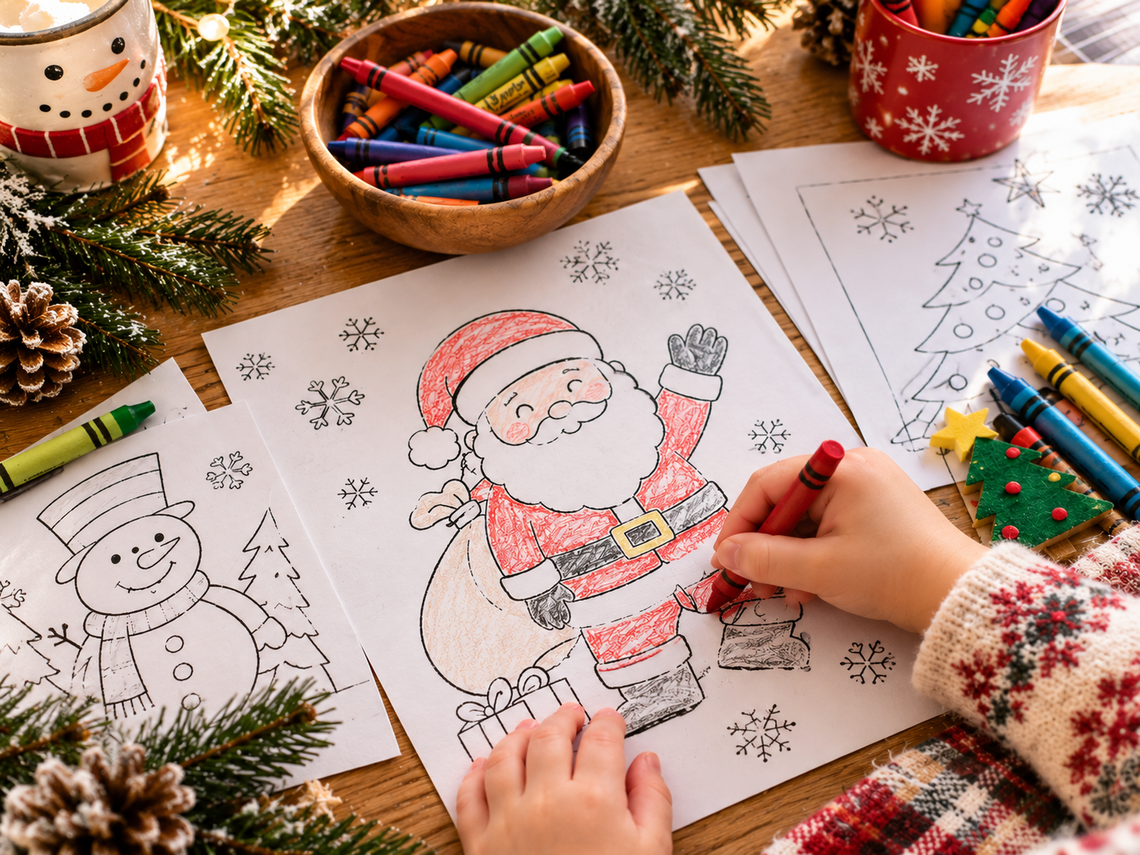
1. Set Up a Christmas Coloring Station
Sometimes the simplest activities are the ones children return to again and again.
A Christmas coloring station is one of my favorite ideas because it requires very little preparation and can be ready whenever you need a quiet activity.
Find a small basket, tray, or box and fill it with Christmas coloring pages, crayons, colored pencils, and washable markers. Add a few holiday stickers if you have them.
You can place the basket at the kitchen table, on a child-sized desk, or at a comfortable spot near where you’re wrapping presents.
Give your children a little creative freedom. They can color Christmas trees, decorate gingerbread houses, design stockings, or invent their own North Pole scenes.
Make it educational: Ask younger children to identify colors, count the ornaments they draw, or describe their pictures. Older children can write a short Christmas story about their finished artwork or create a holiday greeting card.
Why it works: Coloring provides a calming activity that children can pick up and put down without needing to finish everything at once.
A special Christmas coloring book to add to your activity basket
If you’re looking for something more engaging than loose coloring pages, I’d love to share a festive book that fits beautifully into this activity.
I love the idea of using a coloring book that gives children a little story inspiration along with their coloring time. Instead of simply choosing colors, kids can imagine who each elf is, what their job might be at the North Pole, and how they help make Christmas special.
You could even turn it into a little storytelling activity. Have your child choose an elf, give them a voice, and invent a short story about their adventures.
If you’d like to add it to your Christmas activity basket, you can find the book here:
Explore Christmas Elves Coloring Book Volume 2 on Amazon
This is a lovely option to consider if your child enjoys Christmas characters, coloring, and imaginative play.
Disclosure: This post features a book I’m sharing in collaboration with its author. It also contains an affiliate link, which means I may earn a commission from qualifying purchases at no additional cost to you.
2. Create a Christmas Sticker Story
If your children love stickers as much as mine seem to, this activity is worth keeping in your holiday toolbox.
Gather sheets of Christmas stickers, plain paper, and crayons or colored pencils. You can use stickers featuring Santa, reindeer, snowmen, Christmas trees, presents, or winter animals.
Invite your children to create their own Christmas scene.
They might design Santa’s workshop, a snowy village, a busy Christmas Eve, or a magical forest filled with woodland creatures.
The best part? There is no right or wrong way to do it.
For younger children, simply placing stickers on the page is excellent practice for hand-eye coordination and fine motor control. Older children can create a story around their scene.
Try asking questions such as:
- Who lives in this Christmas village?
- What happens when the snow begins to fall?
- How will Santa find his way through the forest?
- What happens next in your story?
If your child wants to dictate their story, you can write it down for them. If they’re already writing independently, encourage them to add a title and a few sentences.
Mom tip: Keep the stickers in a small envelope or reusable container so you can pull this activity out whenever you need it.
3. Build a Cardboard Box Christmas Village
Before you recycle those small boxes from holiday deliveries, consider saving a few for this activity.
A cardboard box Christmas village is an easy way to encourage imaginative play while reusing materials you already have.
Gather small cardboard boxes, paper, crayons, washable markers, glue sticks, and child-safe scissors. You can also add empty tissue boxes, paper tubes, and scraps of wrapping paper.
Show your children how to turn the boxes into little houses, shops, or Christmas cottages.
They can draw doors and windows, add colorful roofs, and decorate each building however they like.
Once the buildings are ready, arrange them together to create a miniature Christmas village.
Your children might add paper trees, toy animals, small figurines, or cotton balls to represent snow. If you have wooden blocks, those can become roads, bridges, or additional buildings.
Homeschool learning opportunity: This activity naturally incorporates geometry, spatial awareness, storytelling, and early engineering skills.
Ask your child how they could make a building taller, what would happen if the houses were arranged differently, or how they could create a road that connects the village.
You can also introduce simple math by counting houses, comparing heights, and sorting buildings by size.
One small caution: Keep small pieces, scissors, and other potentially hazardous materials away from younger children who might put them in their mouths. Battery-operated lights should only be used with appropriate supervision.
Once your village is complete, it can become a special play area your children return to throughout the Christmas season.
4. Make Homemade Christmas Cards
Christmas cards are a wonderful way to combine creativity with kindness.
Set out construction paper, crayons, stickers, washable markers, glue sticks, and a few sheets of festive paper. Let your children decide who they’d like to make cards for.
Grandparents, cousins, neighbors, friends, and community helpers are all lovely possibilities.
Younger children can draw pictures, decorate the front, or make simple handprint designs. Older children can write messages, practice spelling, and add a personal note inside.
You might encourage them to write something as simple as, “Merry Christmas! I hope you have a wonderful holiday.”
This activity helps children understand that a gift doesn’t have to be expensive to be meaningful.
It also creates a natural opportunity to talk about thoughtfulness, gratitude, and showing people that we care.
Make it educational: Have your child write their name, copy a short greeting, or practice addressing an envelope with your help.
You can even turn it into a gentle writing lesson by asking them to think of three things they appreciate about the person receiving the card.
Once the cards are finished, let your children help deliver or mail them.
It’s a simple holiday tradition that teaches kindness in a very tangible way.
5. Have a Christmas Scavenger Hunt
When your children have plenty of energy and you need them occupied for a little while, a Christmas scavenger hunt can be a wonderful solution.
You don’t need to buy anything. Simply create a list of holiday-themed items for your children to find around the house.
For younger children, use pictures or simple descriptions. Older children can read the clues independently.
Here are a few ideas:
- Find something red.
- Find something shaped like a star.
- Find a book with a winter scene.
- Find something soft and fluffy.
- Find a Christmas decoration that sparkles.
- Find something that smells like cinnamon.
- Find three things that remind you of Christmas.
- Find something that could fit inside a stocking.
Give each child a small basket or reusable bag to collect safe objects they find.
For decorations that shouldn’t be touched, children can simply point to the item or draw a picture of it.
Learning opportunity: Scavenger hunts encourage observation, vocabulary development, categorization, and problem-solving.
You can also incorporate math by asking your child to find two round objects, count five red items, or identify shapes around the house.
If you have children of different ages, give older children written clues and younger children picture clues. Everyone can participate without needing the exact same level of challenge.
One helpful trick is to prepare the list before you begin wrapping gifts. That way, you aren’t stopping every few minutes to invent another clue.
6. Set Up a Christmas Play Dough Invitation
Play dough is one of those simple activities that can keep little hands happily occupied while encouraging plenty of creativity.
For a Christmas-themed invitation to play, set out play dough in festive colors along with a few safe tools and accessories.
You might include:
- Red, green, white, and brown play dough.
- Child-safe rolling pins.
- Large cookie cutters.
- Craft sticks for making lines and patterns.
- Large pom-poms for decorating pretend creations.
- A plastic plate or tray to keep everything contained.
Children can make pretend gingerbread cookies, Christmas trees, snowmen, ornaments, or tiny holiday treats.
You can also invite them to create a pretend Christmas bakery.
Perhaps they want to make cookies for Santa, cupcakes for the elves, or a tray of treats for the family.
Homeschool connection: Play dough encourages fine motor development, sensory exploration, creativity, and early mathematical thinking.
Ask your child to make three cookies, create a pattern using two colors, or compare which pretend cookie is bigger.
For younger children, keep the activity simple and supervise closely. Avoid small accessories that could pose a choking risk, especially for children who still mouth objects.
And remember, the creations don’t need to look perfect. The point is to let children explore, experiment, and enjoy making something with their hands.
7. Create a Christmas Nature Collage
If your children need a break from being indoors, this activity offers a gentle way to bring a little nature into your Christmas homeschooling.
Start with a short nature walk around your yard or neighborhood. Depending on what’s available where you live, collect fallen leaves, small twigs, pinecones, and other safe natural materials.
Please leave living plants and protected natural areas undisturbed, and avoid anything sharp, moldy, or potentially irritating.
Once you’re back inside, give your children a piece of cardstock, a glue stick, and their collected materials.
Invite them to arrange everything into a Christmas tree, winter landscape, star, wreath, or abstract piece of art.
You can also provide paper shapes for children who would rather make a collage without using glue on natural materials.
What makes this educational?
Nature collages encourage observation and classification. Children can compare textures, notice different leaf shapes, and describe how materials feel.
You might ask:
- Which materials are rough, smooth, or bumpy?
- What differences do you notice between the leaves?
- Which objects are heavier or lighter?
- What changes have you noticed outside since autumn?
For older children, add a simple nature journal. They can draw what they collected and write a few sentences about their observations.
This activity reminds us that learning doesn’t always need to happen at a desk. Sometimes the best lessons begin with a walk outside and a handful of interesting things.
8. Make a Paper Chain Christmas Countdown
If your children are excitedly asking how many days remain until Christmas, a paper chain countdown can give them something fun to work on while helping them understand the passage of time.
You’ll need strips of colored paper, a glue stick or tape, and a little space to hang the finished chain.
Cut the paper into strips before inviting younger children to participate. Older children can practice measuring and cutting their own strips with appropriate supervision.
Show your children how to connect the strips into loops, linking each new loop to the previous one.
Choose festive colors or create a repeating red-and-green pattern.
Count the loops together and explain that each day, you’ll remove one link as Christmas approaches.
You can make the countdown more meaningful by writing a simple activity or kindness idea on selected links.
For example:
- Read a Christmas story together.
- Make a card for someone.
- Listen to holiday music.
- Bake or decorate cookies.
- Do something kind for a neighbor.
- Spend time looking at Christmas lights.
Keep the activities flexible so the countdown doesn’t become another source of holiday pressure.
Learning opportunity: Paper chains reinforce counting, sequencing, patterns, and calendar awareness.
For preschoolers, counting the links is a great starting point. Older children can help calculate how many days remain or compare the length of the chain as it gets shorter.
It’s a simple decoration that also gives children a visual way to understand the wait leading up to Christmas.
9. Host a Christmas Story Basket
A Christmas story basket is a lovely option for children who enjoy books, pretend play, or a quieter activity during a busy afternoon.
Gather a few favorite Christmas books and place them in a basket with safe props related to the stories.
You might include stuffed animals, fabric scraps, paper stars, toy figures, or simple homemade puppets.
Choose objects that are appropriate for your child’s age and avoid small pieces that could pose a choking hazard.
Invite your child to choose a book and explore the props.
They can look through the pages, retell a familiar story, invent a new ending, or create their own Christmas adventure.
If your child isn’t reading yet, they can tell the story using the pictures. Older children might enjoy writing a different ending or creating a new character.
You don’t need to sit and direct the entire activity. Introduce the basket, explain what’s available, and let your child explore.
Homeschool benefits: Story baskets support language development, imagination, listening comprehension, and early literacy.
They also create a wonderful opportunity for children to revisit familiar stories independently.
If you’re wrapping gifts nearby, you can occasionally ask your child to tell you about the story they’re creating without needing to stop what you’re doing.
It’s a gentle reminder that children can learn through play just as much as through formal lessons.
10. Make a Christmas Craft-and-Create Box
My final idea is less of a single activity and more of a little holiday survival tool.
A Christmas craft-and-create box gives children a collection of safe supplies they can use to invent their own projects whenever they need something to do.
Instead of preparing a new activity every time boredom strikes, gather a selection of materials in one container.
You might include:
- Construction paper and cardstock.
- Crayons and washable markers.
- Christmas stickers.
- Glue sticks.
- Child-safe scissors.
- Paper plates.
- Empty cardboard tubes.
- Scrap paper and wrapping paper.
- Ribbon scraps that are safe for your child’s age.
- Christmas-themed coloring pages.
Store the box somewhere accessible and introduce it when you have time to explain the basic rules.
You can give your children a simple challenge, such as making a Christmas decoration, designing a gift for someone, or creating something for their pretend North Pole workshop.
After that, let them take the lead.
For children ages 4–8, an open-ended activity can be especially rewarding because there isn’t one correct outcome. They can experiment with different materials, solve little problems, and change their plans as they go.
For safety, keep staplers, sharp tools, plastic bags, and other potentially hazardous materials out of reach. Supervise scissors, adhesives, and craft supplies according to your child’s age and abilities.
The secret to making this work: You don’t have to provide endless entertainment. You’re simply giving your children the tools and space to explore their own ideas.
And that can be a wonderful gift in itself.
Bonus Activity: Discover Christmas Around the World 🌎
Looking for a screen-free Christmas activity that adds a little learning to your holiday fun? Exploring Christmas traditions around the world is a wonderful way to introduce children to geography, different cultures, and unique ways families celebrate the season.
If you’re looking to add something educational to your December homeschool plans without spending hours preparing a lesson, I’ve created Discover Christmas Around the World: A Fun and Educational Mini-Lesson to help make learning a little easier.
It’s a lovely way to bring some extra curiosity and discovery into your Christmas homeschool days!
How to Keep Kids Busy While You Wrap Christmas Gifts
Having a list of screen-free Christmas activities is helpful, but a little planning can make the difference between an enjoyable afternoon and constantly being interrupted.
Here are a few things I’ve found worth considering.
Prepare activities before you need them
If you’re already surrounded by wrapping paper, tape, and gift bags, the last thing you want is to search for craft supplies.
Choose two or three activities ahead of time and place everything in separate baskets or containers.
That way, you can hand your child an activity without needing to organize the entire house first.
Match the activity to your child’s age
A four-year-old may enjoy coloring, stickers, or play dough with occasional help. A seven- or eight-year-old may prefer a scavenger hunt, a cardboard village, or a more involved craft.
Think about what your child can reasonably do independently rather than choosing an activity simply because it looks impressive.
Set realistic expectations
Some children will happily color for twenty minutes. Others may be ready for something new after five.
That’s normal.
You can rotate activities, offer a short movement break, or invite your child to help with a safe part of the task when appropriate.
The aim isn’t to guarantee an uninterrupted hour. It’s to make the busy season a little easier for everyone.
Create a special Christmas activity basket
One simple idea is to keep a basket specifically for December.
Include a few coloring pages, stickers, Christmas books, and other quiet activities. You can rotate the contents every few days to make familiar materials feel interesting again.
If you homeschool, this basket can also become part of your seasonal learning routine.
Let children help when they want to
Not every child wants to play independently all the time, and that’s okay.
Some children enjoy helping sort gift tags, count bows, or carry lightweight supplies to the wrapping area.
As long as the task is safe and doesn’t involve handling hidden gifts, sharp tools, or other hazards, giving children a small role can help them feel included.
You can also explain that you’ll spend a little time wrapping gifts and then reconnect for a story, snack, or another activity.
Predictable expectations can make waiting easier for young children.
A Gentle Reminder for Homeschool Moms at Christmas
It’s easy to feel as though we need to make every holiday moment magical.
We see beautiful Christmas crafts, elaborate traditions, carefully planned activities, and picture-perfect homes, and suddenly our own ordinary December afternoon doesn’t feel like enough.
But your children don’t need a perfect Christmas to have a meaningful one.
They need opportunities to play, explore, connect, and feel loved.
Sometimes that looks like an elaborate Christmas craft. Sometimes it looks like a coloring book at the kitchen table while you wrap presents nearby. And sometimes it means putting everything aside for a little while and enjoying a Christmas story together.
All of those moments can be worthwhile.
As homeschool parents, we have the opportunity to weave learning into the rhythms of everyday life. Counting paper-chain links becomes math. Making Christmas cards becomes writing practice. Building a cardboard village becomes an opportunity to explore engineering and imaginative storytelling.
You don’t need to turn every activity into a formal lesson, either.
Let your children enjoy the process. Ask questions when they’re curious. Give them room to make mistakes, change their minds, and create something unexpected.
And please remember to give yourself a little grace, too.
The gifts will get wrapped. The holiday will arrive. And the small, ordinary moments you share along the way are often the ones that matter most.
Make This Christmas a Little More Peaceful
If you’re looking for ways to keep little hands busy without turning to screens, I hope these ten screen-free Christmas activities give you a few ideas to try this season.
From a simple coloring station to a cardboard Christmas village, there’s something here for different ages, interests, and energy levels.
You don’t need expensive supplies or hours of preparation. Start with one activity, gather what you already have, and see what your children enjoy.
And if your child loves coloring and imaginative Christmas characters, consider adding Christmas Elves Coloring Book Volume 2 to your holiday activity basket. It’s one more way to encourage a little creativity while you finish those Christmas preparations.
Ready to make your December a little easier?
Save this post to Pinterest so you can return to these screen-free Christmas activities whenever you need a quick idea. Share it with a fellow homeschool mom who could use a little extra breathing room this holiday season, and explore more seasonal homeschool inspiration here at Cleverly Kindred.
You don’t have to do everything. You just need a few good ideas, a little flexibility, and permission to keep things simple.
I hope these screen-free Christmas activities help you create a more peaceful holiday season filled with creativity, meaningful play, and special memories with your children.
Leave a Comment!
I’d love to hear from you!
Which of these screen-free Christmas activities would your children enjoy most? Are your little ones happiest coloring, making crafts, building imaginary worlds, or heading outside for a Christmas scavenger hunt?
Leave a comment below and share your favorite ways to keep kids happily occupied during the holiday season. Your ideas might be exactly what another homeschool mom needs this Christmas!
Let’s encourage one another and make this season a little more joyful, one simple activity at a time.
🎁 Explore More Christmas Favorites!
👉 See all Kids’ Christmas Craft Supplies (Amazon)
👉 Browse Christmas Children’s Books (Amazon)
👉 See Christmas Learning Toys & Games (Amazon)
👉 Find Budget-Friendly Stocking Stuffers for Kids (Amazon)
👉 Top Christmas Gifts for 5–8-Year-Olds (Amazon)
👉 Best Christmas Gifts for 9-12-Year-Olds (Amazon)
👉 Christmas Family Activity Kits (Amazon)
Related Posts You Might Enjoy:
- The Ultimate Homeschool Starter Kit: Everything You Need in One Place
- New to Homeschooling? Here’s Everything You Need to Know to Get Started
- How to Create a Cozy Christmas Morning with Kids (That’s Calm, Joyful, and Full of Magic)
- Top 10 Christmas Books for Kids Who Love Science & Learning (so you’ll actually get them excited — and learning)
- Top 10 Christmas Gifts for Kids Who Love Science & Learning
- Christmas Around the World: How 6 Countries Celebrate the Holidays
- Our Favorite Family Holiday Traditions (and Little Things That Make Them Magical)
- Best Books to Read with Your Kids This Christmas Season (so you can make memories — and actually enjoy story time)
Thank you for reading my blog! Stay tuned for more tips, resources, and printable materials to help make your homeschooling experience enjoyable and effective. Check out my store for a variety of educational products and printables to assist you on your homeschooling journey.
~With love,
Cleverly Kindred ❤️
You May Also Like
Christmas Homeschool Activities: December Fun, Crafts & Learning Ideas

25 Easy Christmas Crafts for Kids (No Special Supplies Needed)